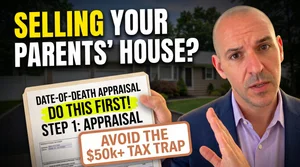
By Eric Berman, REALTOR® | The Eric Berman Team at Compass
Full video: Selling Your Home After 60 on Long Island (15:10)
TL;DR:
Selling a long-held Long Island home after 60 is often the right move, and three financial facts should be checked before it gets made. First, Enhanced STAR and the Senior Citizens Homeowners’ Exemption can stack into real annual savings, they’re tied to the specific house and primary residency, and they stop the day it sells — they don’t follow the owner to the next place, which means reapplying from scratch and hitting a new deadline. Second, the federal capital gains exclusion on a primary residence has been $250,000 for a single filer and $500,000 for a married couple since 1997 and has never been indexed for inflation, so a house bought on Long Island decades ago frequently carries gain well above it. Third, selling can convert a protected asset into countable cash in long-term care planning, which is an elder law attorney’s question and nobody else’s. None of these are reasons never to sell. They’re reasons the CPA call comes before the listing call.
An Agent’s Argument for Not Hiring One Yet
Worth stating the conflict of interest plainly, since it shapes everything below. Listing agents are paid when houses sell. The people making videos about whether to sell a house want the listing, and that includes the person who made this one.
The video opens by naming that, and the reason is simple enough: there are three financial reasons a Long Island homeowner over 60 might be better off not selling yet, and almost nobody covers them, because covering them costs listings in the short run. The better version of this business is getting the call at the right time rather than the earliest possible time.
What follows isn’t legal, tax, or financial advice, and it isn’t close. It’s a list of what to ask, who to ask, and why each question carries money attached. Homeowners who can answer all three and still want to sell should sell. Homeowners who can’t answer them aren’t ready to decide yet.
The Exemptions That Stop the Day the House Sells
Most Long Island homeowners over 65 who qualify for property tax relief know they’re receiving it. Far fewer have ever calculated what it’s worth annually, and almost none have been told it ends at closing.
Two programs matter most here, both New York State programs applying across Nassau and Suffolk, with income limits and reduction amounts that vary somewhat by town and village. Enhanced STAR reduces the school tax portion of the bill for homeowners 65 and older below an income threshold. The Senior Citizens Homeowners’ Exemption, usually called SCHE, is separate — it reduces county, town, and school taxes on a sliding scale keyed to income. The video walks through both using Nassau as the example.
The piece that generates the real money is that the two can stack. An eligible homeowner can hold Enhanced STAR and SCHE simultaneously, and for someone near the lower income thresholds the combined annual reduction is substantial. The video is emphatic on the stacking, because homeowners frequently know about one and have never applied for the other.
Current figures, which are adjusted periodically and should be confirmed with the local assessor: Enhanced STAR’s income limit sits around $110,750, and Nassau’s SCHE limit around $58,399, with reductions on a sliding scale by income band.
Here’s what nobody mentions. Both exemptions attach to the house and to primary residency, which means they stop the day it sells. They do not follow the owner. They do not transfer to the next property. A homeowner who buys a condo or a 55+ community home afterward applies again from the beginning — different property, different assessment, different town or village rules, and a new deadline to hit. In Nassau the taxable status date is January 2, which is earlier than most of New York State, and applications for the following tax year have to be in by early January. Missing it costs a full year of benefit.
The takeaway is narrow and concrete. Any homeowner receiving these exemptions should know the annual dollar figure before deciding anything, because that number is a real part of the cost of staying — and it disappears at closing.
A Capital Gains Cap Frozen Since 1997
This affects more Long Island sellers over 60 than any other tax rule, and the reason is arithmetic rather than policy.
The Section 121 exclusion lets a homeowner exclude a set amount of gain from the sale of a primary residence: $250,000 for a single filer, $500,000 for a married couple filing jointly. The video names the date those figures were set — the Taxpayer Relief Act of 1997, nearly thirty years ago, never adjusted for inflation since.
Run that against a real Long Island ownership history. The video works an example: a house purchased in the 1980s for $150,000 and sold today for $1.6 million produces roughly $1.45 million in gain. A married couple excludes the first $500,000. The remaining million is taxable as long-term capital gain — zero, fifteen, or twenty percent federally depending on income, with a possible 3.8 percent net investment income tax on top. Depending where that income lands, the federal bill on that profit alone can run from nothing to something in the neighborhood of $240,000.
Two things make this land harder after 60.
The first is the surviving spouse window. The video covers it carefully, and the timing is unforgiving: a surviving spouse generally has two years from the date of death to sell and still claim the full $500,000 exclusion, provided the home met the requirements before the death and there has been no remarriage. Past that window it drops to $250,000. For a long-held Long Island house, that difference can run to tens of thousands in additional tax. Anyone who has lost a spouse recently and is weighing a sale should raise the timing with a CPA before deciding anything, and that is a recommendation to make a phone call rather than tax advice.
The second is documentation, and it’s the one homeowners can still act on. Capital improvements raise cost basis, which lowers taxable gain. A kitchen added in 1992, a roof replaced in 2005, an addition built in 2014 — each can be added to basis, but only with proof. The video is direct about what that means practically: somewhere in the attic or the basement there may be permits, contractor invoices, material receipts, and canceled checks that are worth real money to the tax outcome. Most people threw them out two decades ago. Anyone who still has them should pull them into a folder before listing, because once the sale closes the gain is calculated against whatever basis can be proven and nothing else.
The short version: the cap hasn’t moved since 1997, and a Long Island home held thirty or forty years has probably outgrown it. Which means the CPA comes before the listing agent.
The Medicaid Question
This section is short on purpose, and the brevity is the point.
Selling a home can affect Medicaid eligibility later. In some circumstances the house is a protected asset, and selling it converts that protection into cash that counts. Whether any of that applies to a particular family depends on the specific situation, New York’s current rules, and planning that elder law attorneys do every day. The video declines to go further, which is the correct call.
Anyone approaching an age where long-term care may enter the picture, or already navigating it for themselves or a spouse, should not sell without first speaking to an elder law attorney who handles New York Medicaid planning regularly. Not an agent. Not a general practitioner. That’s the whole of what an agent should say about it.
When Selling Clearly Does Make Sense
Those three items are reasons to pause, not reasons to stay forever. Often the honest answer is that it’s time.
Carrying cost is the first and most measurable. Property taxes, insurance, utilities, lawn care, snow removal, maintenance, repairs — totaled honestly and set against what the alternative actually costs, the math sometimes simply says go. The video runs through the comparison without putting a thumb on the scale.
Practical fit is the second, and it’s usually the real one. A house that no longer suits the life someone wants to live is a legitimate reason to move, whether it’s too large, too isolated, too far from the people who matter, or too much to manage. Travel becomes harder when a house is a tether. Grandchildren settle elsewhere. A smaller place up here and somewhere warm for the winter starts to look like the better arrangement.
Maintenance is the third. A house forty or fifty years old needs a roof, a heating system, updated plumbing, a repaired driveway. At some point the question stops being whether those are affordable and becomes whether anyone wants to keep writing the checks.
And then there are the stairs. A multi-level house works for a long time, and when the stairs become something a homeowner thinks about rather than something they don’t, a single-level home starts making sense. That’s a reasonable thing to weigh out loud rather than quietly.
Where the Equity Actually Goes
For a homeowner who decides to sell, there are three realistic destinations, each with its own cost structure, its own tax picture, and — this matters more than it sounds — its own exemption application to file.
A smaller single-family house is the simplest version: the same type of property, less of it, lower carrying costs, often lower taxes, less to manage.
Attached housing is the second, and availability varies enormously by town. Port Washington, Garden City, Rockville Centre, Great Neck, and Mineola all carry meaningful condo and townhouse inventory, with one- and two-bedroom units in ranges that work for a lot of downsizing budgets. The video flags the counterpoint: plenty of Long Island towns have almost none, which is worth establishing before narrowing a search around a town that can’t deliver the housing type.
A 55+ community is the third — age-restricted housing, permitted under federal fair housing law, generally lower-maintenance with community amenities and often lower carrying costs than a traditional single-family house. The rundown of 55+ communities across Long Island is a reasonable place to start narrowing that field.
The thread running through all three is that nothing carries over automatically. New property, new assessment, new application, new deadline. Which is the clearest illustration of the argument underneath this whole post: this is a financial decision that happens to involve real estate, rather than a real estate decision with some financial consequences. For homeowners who need to sell before they can buy, the guide to selling and buying at the same time on Long Island covers the sequencing, and a current valuation sets the budget for whichever path gets chosen.
Forty Years of House, and Forty Years of Stuff
A Long Island home held thirty or forty years almost always carries at least one of the issues that complicates a closing. The video lists the usual suspects: a buried oil tank from before the gas conversion that nobody can confirm was properly closed, an unpermitted addition with no Certificate of Occupancy, a cesspool or older septic system, and maintenance quietly deferred over two decades.
None of these are emergencies. All of them cost less to find now, with time to resolve them, than during attorney review on a contract when the buyer’s lawyer is asking questions nobody can answer. The expectation to set is simply that something will turn up, and that finding it early is the cheap version.
Then there’s the part that stops more of these moves than any tax rule. Forty years of possessions — furniture, photographs, paperwork, the attic, the basement, the garage. The video is honest that this is the real obstacle, more often than taxes or market conditions. Senior move managers exist as a profession specifically for this: sorting, packing, donating, selling, and moving after decades in one house. They’re worth knowing about before anyone concludes the move is impossible, and the full guide to downsizing a Long Island home covers the sequence in detail. Sometimes the obstacle isn’t the house or the tax bill. It’s the stuff, and the stuff has professionals too.
A Composite Decision, Start to Finish
The following is a composite drawn from several similar situations, with details changed.
A widowed homeowner in her seventies had been in the same Nassau County house since the early 1980s. Her children were pushing gently toward a 55+ community, and she was close to agreeing. The house was large, the stairs had started to register, and the maintenance list kept growing.
Three things came out of the first conversation. She was receiving Enhanced STAR and had never heard of SCHE, despite almost certainly qualifying — which meant she had been leaving money on the table for years and the first call was to the assessor rather than to anyone else. Her husband had died fourteen months earlier, which put her inside the two-year window for the full $500,000 exclusion rather than the $250,000 she would face after it. And a box in the basement held permits and contractor invoices going back to a 1994 addition and a 2008 roof.
Her CPA ran the numbers with the receipts included and the full exclusion applied. The gain still exceeded the exclusion, but by considerably less than it would have in either of the other two scenarios, and the timing turned out to matter more than anything else on the list. She sold inside the window, applied for the exemptions on the new home in early January rather than discovering the deadline in March, and the move went through.
None of that was clever. It was a sequence of phone calls made in the right order, and the order was worth real money.
Where to Start
In order. First, find out what the current exemptions are worth annually, and whether any are being left unclaimed — the assessor’s office can answer both. Second, talk to a CPA about capital gains exposure, with particular attention to the surviving spouse window if it applies. Third, go find the improvement receipts before anything is thrown out. Fourth, if long-term care is anywhere in the picture, speak to an elder law attorney before making any decision. Fifth, cost out the realistic destinations, including what the exemptions would be worth on each and when the application is due. Only then does the listing conversation make sense.
The Honest Bottom Line
Three questions decide this, and they have answers.
What are the current exemptions worth every year, and what happens when they stop? What is the capital gains exposure, and do the receipts exist that would reduce it? How does the situation interact with long-term care planning, and has an elder law attorney looked at it?
A homeowner who can answer all three and still wants to sell should sell — that’s a decision made with the whole picture visible, which is the only kind worth making at this stage. A homeowner who can’t answer them isn’t ready yet, and the three calls it takes to get there are cheap relative to what they protect.
Staying is also a legitimate outcome. Nobody has to move. The right answer is the one that fits the actual financial situation and the life someone actually wants, and sometimes that answer is to stay put for another five years. More on selling across the region sits in the Local Insights library. For anyone weighing this now, a conversation about the specific situation — including the possibility that the honest answer is not yet — is usually more useful than more reading, with no pressure attached.
A note on scope: this post covers real estate strategy and market context, not legal, tax, or financial advice. Exemption thresholds, tax rules, and Medicaid regulations change, and every situation has its own facts. Specific decisions should be reviewed with a CPA, a New York real estate attorney, and — where long-term care may be involved — an elder law attorney.
FAQs
What property tax exemptions do Long Island homeowners lose when they sell?
Primarily Enhanced STAR and the Senior Citizens Homeowners’ Exemption, known as SCHE. Enhanced STAR reduces the school tax portion of the bill for homeowners 65 and older below an income threshold. SCHE separately reduces county, town, and school taxes on a sliding scale by income, and the two can be held at the same time, which is where the meaningful savings come from. Both attach to the specific property and to primary residency, so they end at closing and do not transfer to a next home. Reapplying means a new application, a new assessment, and a new deadline — in Nassau, a taxable status date of January 2.
How much capital gains tax do Long Island sellers over 60 pay?
It depends entirely on gain and income, but the structural issue is that the federal exclusion hasn’t moved since 1997. A single filer can exclude $250,000 of gain on a primary residence and a married couple filing jointly $500,000, with no inflation adjustment in nearly thirty years. A Long Island home bought for $150,000 in the 1980s and sold for $1.6 million produces roughly $1.45 million in gain, leaving about $1 million taxable after the joint exclusion — taxed federally at zero, fifteen, or twenty percent depending on income, plus a possible 3.8 percent net investment income tax. A CPA should run this before listing, not after.
Does the $500,000 capital gains exclusion still apply after a spouse dies?
For a limited time, yes. A surviving spouse generally has two years from the date of death to sell and still claim the full $500,000 exclusion, provided the home met the ownership and use requirements before the death and the survivor has not remarried. After that window the exclusion drops to $250,000, which on a long-held Long Island home can mean tens of thousands of dollars in additional federal tax. Anyone who has recently lost a spouse and is considering a sale should raise the timing with a CPA early, since the window is fixed and the difference is substantial.
Can home improvements reduce capital gains tax on a Long Island home sale?
Yes, with documentation. Capital improvements made over the years — a kitchen renovation, a roof replacement, an addition — raise the home’s cost basis, which reduces taxable gain dollar for dollar. The requirement is proof: permits, contractor invoices, material receipts, and canceled checks. Once a sale closes, the gain is calculated against whatever basis can be substantiated, so undocumented work generally doesn’t count. Homeowners who still have records from decades of improvements should gather them into one folder before listing, because for a long-held home that paperwork can be worth a meaningful amount.
Should someone over 60 sell their Long Island home or stay?
Both are legitimate, and the answer turns on three questions. What are the current property tax exemptions worth annually, and what does losing them cost? What is the capital gains exposure after the exclusion, and does documentation exist to reduce it? And does the situation interact with long-term care planning in a way that requires an elder law attorney’s review first? Alongside those sit the practical factors — carrying costs, maintenance, stairs, and whether the house still suits the life being lived. A homeowner who can answer all three financial questions and still wants to move is making a well-informed decision either way.
By Eric Berman, REALTOR® | The Eric Berman Team at Compass
Eric Berman | Long Island & Queens Associate Broker | Compass
1468 Northern Blvd, Manhasset, NY 11030
(917) 225-8596 | eric@ericbermanre.com | theericbermanteam.com